Something's happening underneath Changchun. A subway system is on its way. The ground rumbles with approval. Traffic is happily diverted. Progress won't be stalled, but it's not a pretty sight. So they decided to decorate.
A new campaign has made its way north called Zhongguo Meng: The Chinese Dream. Culture boards all over the country have submitted one or more slogans with beautiful artwork attached. Street by street, the effect is like an outdoor museum of propaganda.
Reading most of the posters is simple enough. Paired with the art, it isn't difficult to understand (or at least guess) their meaning. When a few of them started to trump me and my dictionary, however, I called on Jin Jin. Some have historical references to poems or songs that I hadn't heard of. Some of them include contemporary poetry. They are all concise and poignant in their simplicity. The artwork adds a warmth and aesthetic beauty to the idealistic thoughts shared. It might be propaganda, but it's very moving. Here are a few of my favorites with their translations and Jin Jin's helpful explanations where necessary.
Filial Piety
The Chinese bloodline
Store every grain
Treasure grains and use them prudently
Jin Jin says, "When Xi Jinping [China's new president] came to office his "Chinese Dream" advocated for less waste. In homes and hotels especially, people need to take appropriate measures, so think that "Ke li gui cao" goes along with this idea."
Get yourself to work
Be well-clothed and well-fed
The nation's dream
A crane circling towards the heavens
This particular poster had my brain all twisted for how to translate its poetic sense. First of all, it uses the word "Zhong hua" instead of "Zhong guo" to mean China. Zhong guo is a modern term whereas Zhong hua is an ancient poetic form. According to Jin Jin, it also exudes a more patriotic connotation. In ancient times, the phrase was used to describe the nine states within the nation. The second half of the poster provides an image of a crane, an animal that symbolizes propitiousness in Chinese rhetoric, circling towards the "nine" heavens. As Jin Jin explains: Since "Zhonghua" has nine states, it is only fitting to infer the nine heavens above them. Lastly, instead of just using "meng" to say "dream," they used the term 圆梦, "yuan meng." Jin Jin tells me that it points to the way that China rose up both in ancient and recent times to stand on their own feet, and to the promise that they can continue to rise.
The Communist Party is good
Socialism is good
"Reform and Opening" is good
This is one of my favorites simply for its boldness. It's frank, simple, and full of faith. "Reform and Opening" refers to China's 1978 policy to open its doors to the outside world again.
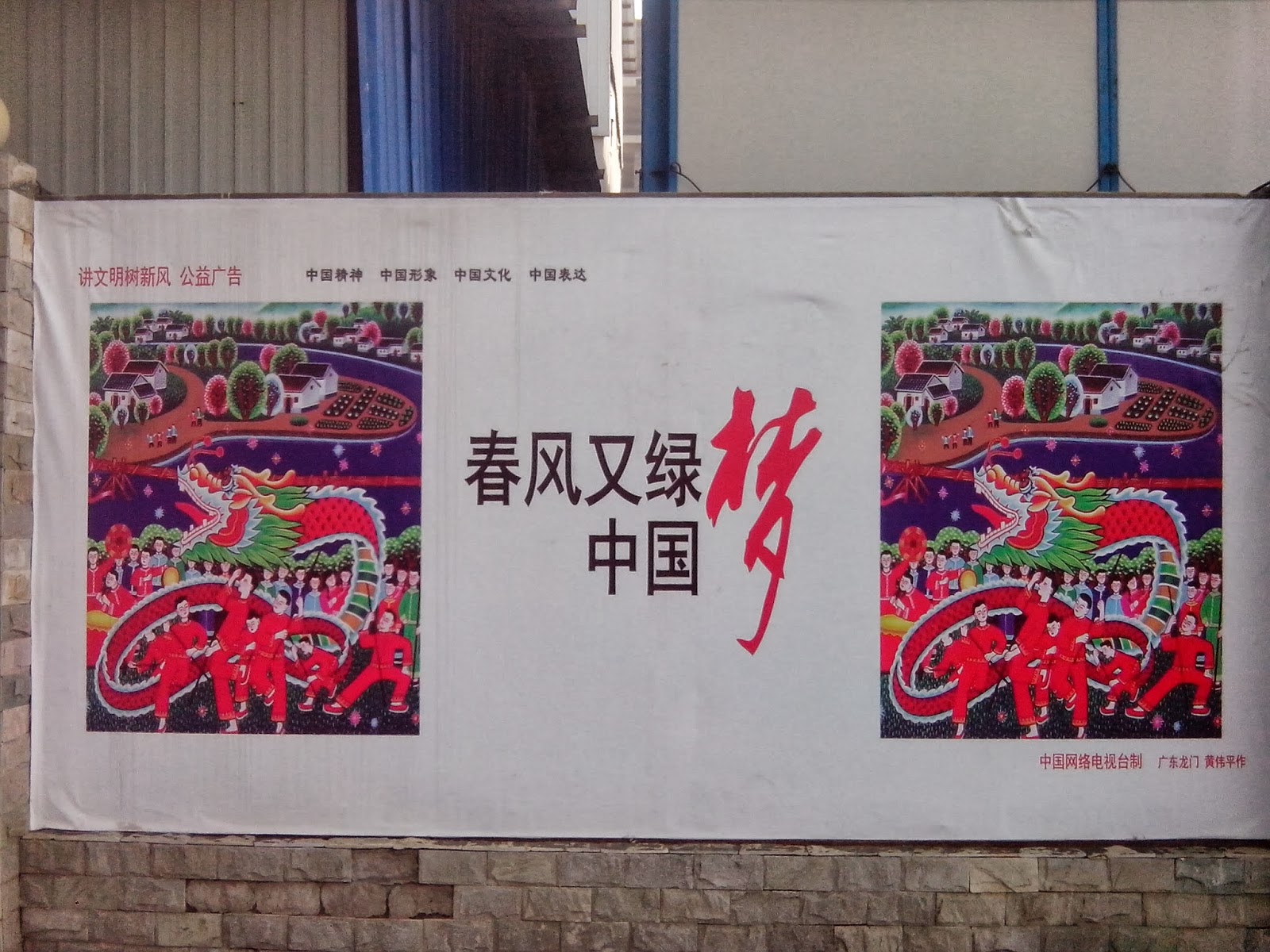
A spring breeze and a return to green
The China Dream
If you look closely at the poster you can see people doing the dragon dance, a tradition after the Chinese New Year, also referred to as the "Spring Festival." At this time of year, the frozen land begins to thaw, trees are graced with leaves again, and flowers begin to bloom. Jin Jin informs me that the first line refers to a famous poem that starts: "A spring breeze and a return to green along the banks of the southern Yangtze." Here, "The Chinese Dream" is written in place of China's famous river, implying that China's dreams are easiest to come by in the spring when everyone is happy and living the sweet life.
My keeping fit
My foretelling
There's that "yuan meng" again. It can literally mean a prognostication by dreams, which when combined with the idea of a "Chinese dream," one can understand that it can mean a foretelling of one's rise to success. Here the rise would be through fitness.
Sing of the homeland
"The five stars on ou red flag welcome the wind to make it flutter..."
Hardworkers
have a lot of luck
China--Onward and up!
China's spirit of youth lies in high aspirations
Jin Jin informs me, "China has a famous saying: When the young are strong, the country is strong." In the pictures, children are flying kites, symbolizing both their youth and vigor as well as their ability to soar.
Socialism is good
Hundreds of happy children
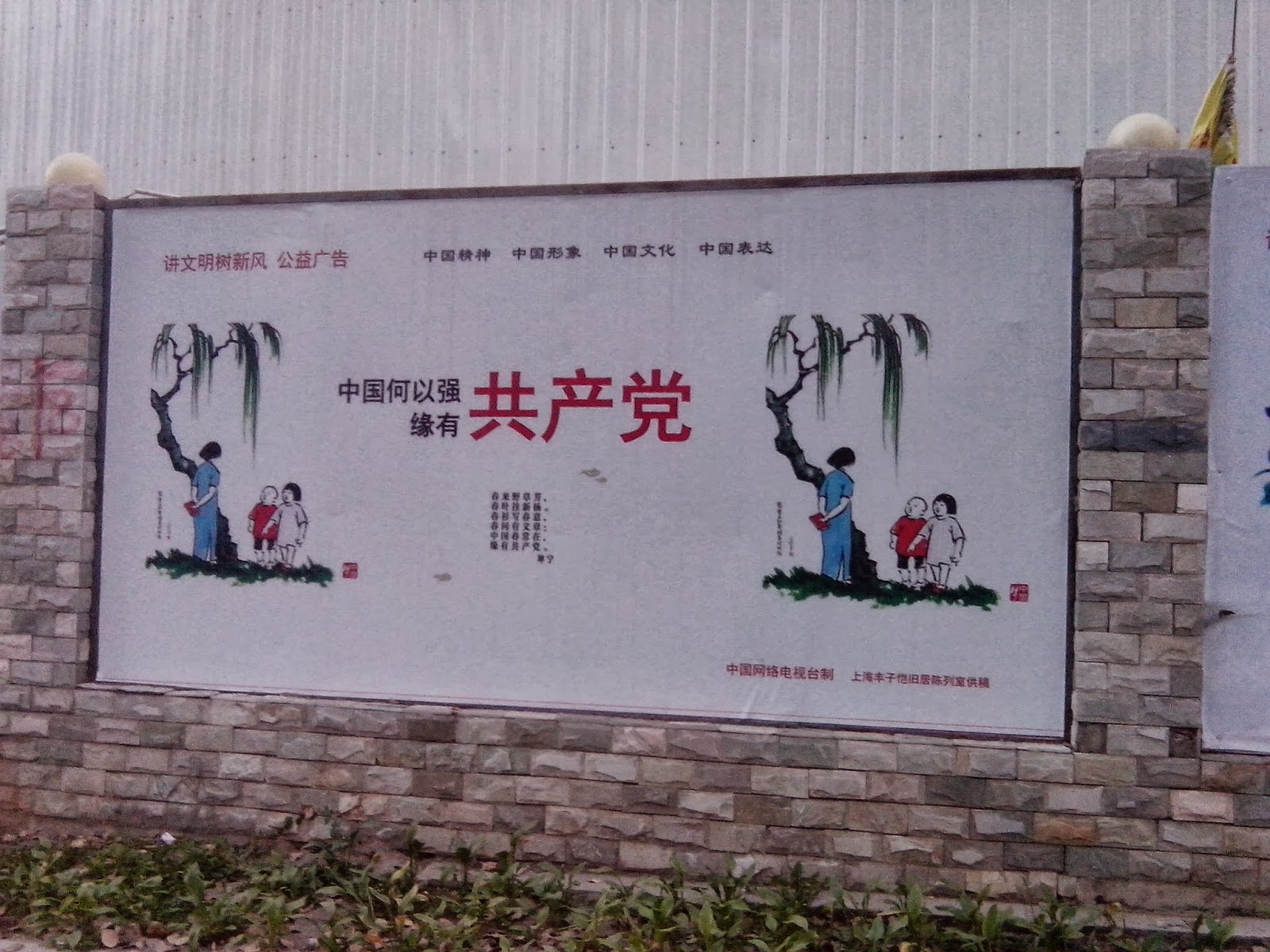
Why is China strong?
Because it has the Gongchangdang! (a.k.a. Communist Party)
China will live on endlessly