Showing posts with label collective memory. Show all posts

Monday, August 25, 2014

Yalu River Broken Bridge


Entrance to the bridge and memorial
 
 
Only two hours or so inland from the Yellow Sea and at the mouth of the Yalu River lies Dandong. It being a port city and because of its location on the border of China and North Korea, it has seen its share of historic events in the last century. It inevitably houses a lot of bridges, many of which were built during the Japanese occupation and then bombed during the Korean War. More famous due to its being the first railway bridge, the Yalu River Broken Bridge is a top tourist attraction when visiting Dandong. 


Under the Broken Bridge looking at the Friendship Bridge


People flock to see traverse the Broken Bridge


Looking pretty by some vestiges of war


The bridge used to be a railway


A stele memorial looking out to the Friendship Bridge (still connected to China's neighbor)


Trying to recreate the 1940's photos of the bridge
 
 
One cool thing about the bridge is its middle panel which, in its heyday, rotated to create a path for passing ships. Then it was bombed by the American Army during the war. The gears for the rotating panel still stand, but where the bridge ends is a tangled mass of steel.


At the site of the bombing
 
 
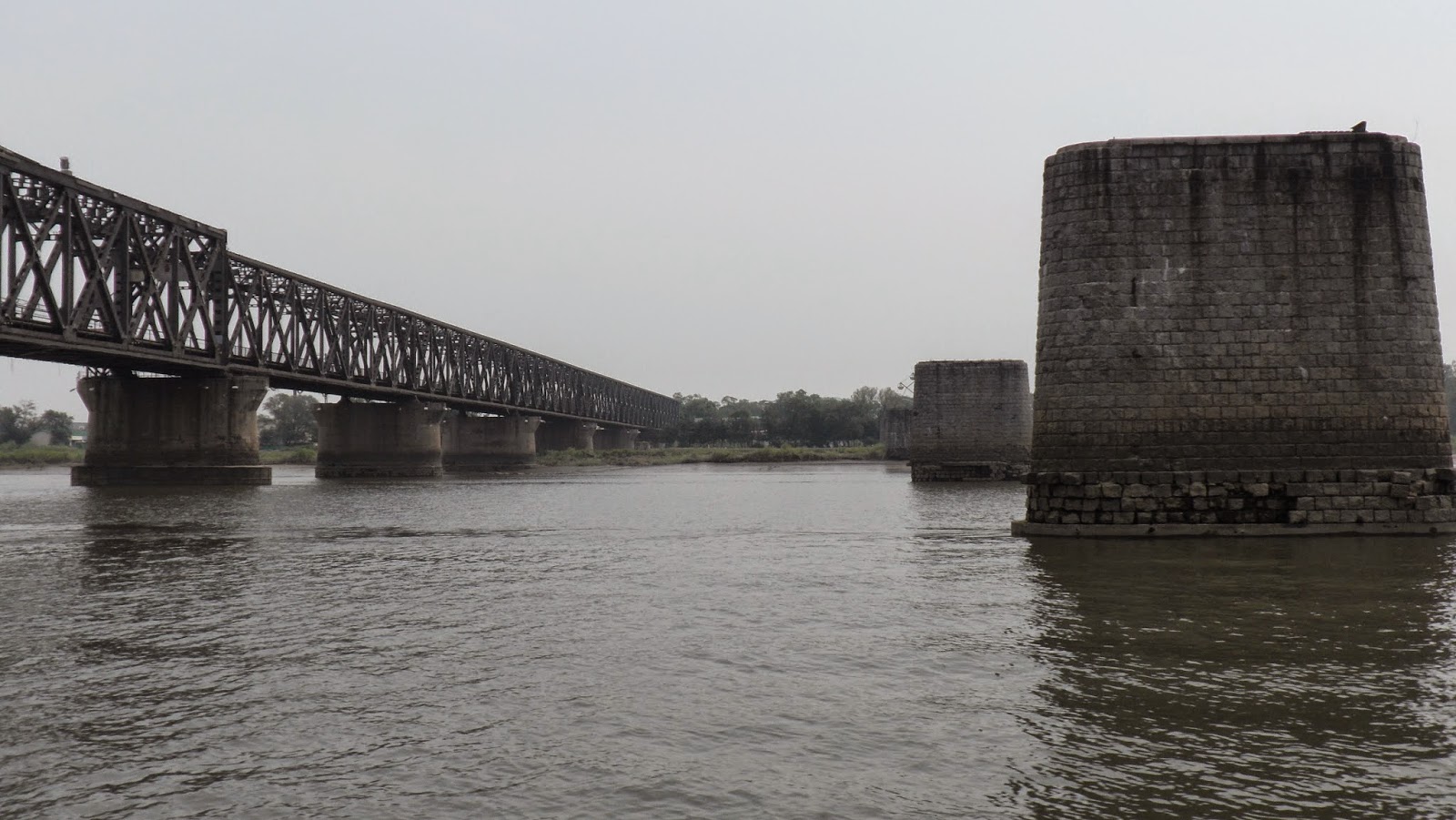
To give you a picture of how long the bridge is (over 900 meters), here is what's left of the Broken Bridge next to the Friendship Bridge, which people still use to get to and from North Korea. These photos are taken from the halfway point, or where the bridge was bombed.


Now it's time to play "Which Side is Which?"! Here's how it works: I show you a photograph and you guess which country it shows, China or North Korea.


China or North Korea?


China or North Korea? 


China or North Korea?


China or North Korea?


Chinese or North Koreans?


China or North Korea?


Chinese or North Korean?


Chinese or North Korean?
Just kidding! They're birds...get it?


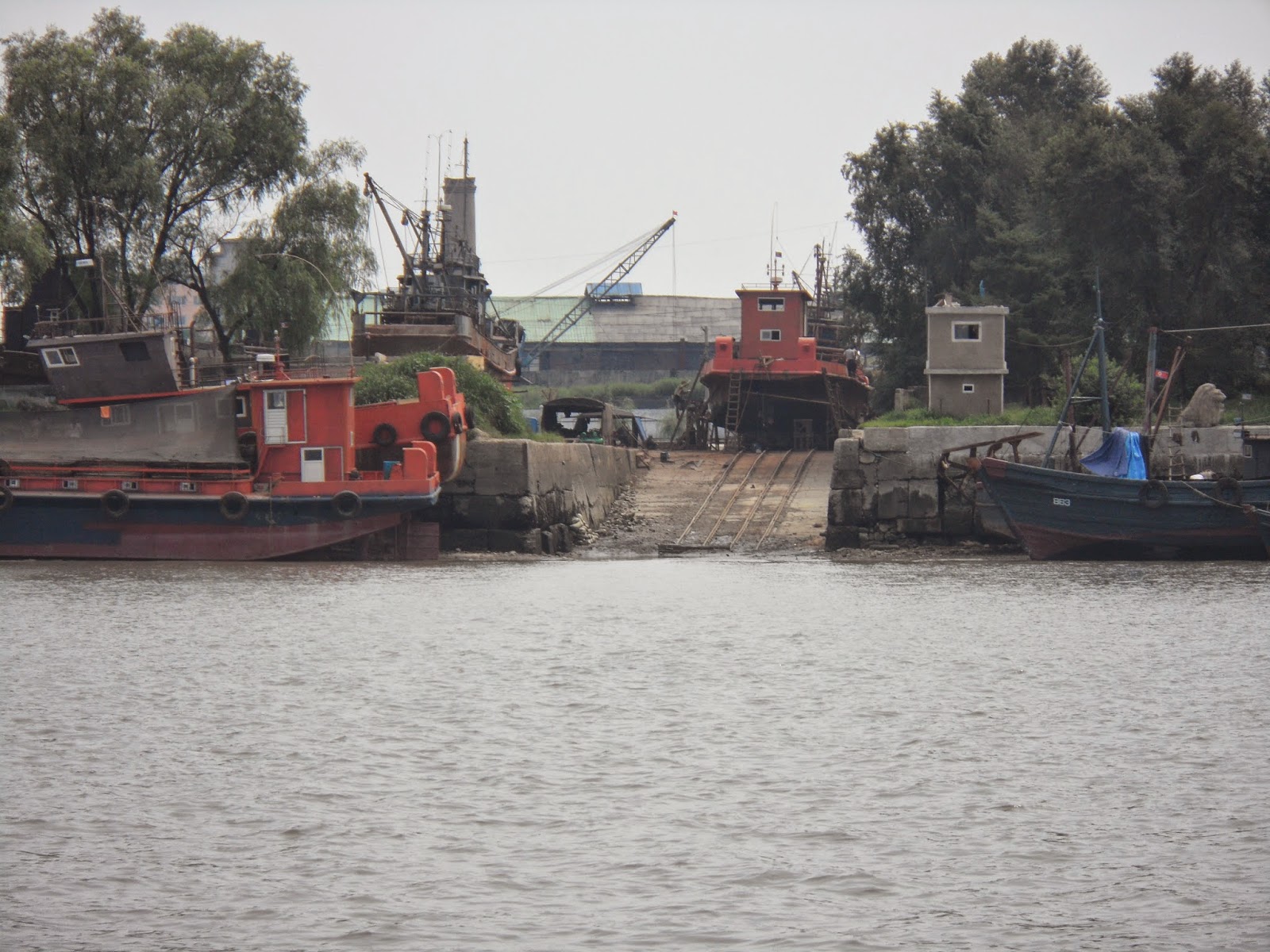
Here are just some fun pictures from the boat ride. We're right in the middle of the river, so I can't ask you to guess who owns what (although I'm sure there's an answer).


The Friendship Bridge


Lazy me got the best view


A mysterious North Korean house/office boat
 
 
I won't make you guess. This is a North Korean boat and we're completely at a loss as to what it's used for. If you look closely at the back, caged part you'll see something that confounded us even more.


Do you see it yet?


Could it be? There's a basketball court onboard! What?!


I wonder if it's Kim Jung-Ohn's personal basketball/business yacht, but I suppose that's a question for another era.


Monday, October 28, 2013

"The Sound of Youth" Radio Show Interview


Through the International Students' Association, I had the opportunity this week to participate in a radio interview. The show is called "The Sound of Youth" and is a daily program focusing on activities and stories from Changchun's plethora of universities. In our interview, three Chinese students from our association as well as another foreign student, Hadi, and myself discussed life in China and the importance of our club's activities for foreign students. Our hostess particularly enjoyed asking Hadi and I about our experiences studying Chinese and living in China. At one point, she even asked the other students to talk about both Hadi and I as individuals. If it had been television, you would have seen me blushing profusely.

The whole time I kept imagining Changchun's taxi drivers joining in the program. "Not bad," they'd think. "They speak Chinese pretty well," their passengers would reply. Maybe one of the millions out there would wonder, "Have I driven these Lao wai before?"  

Unfortunately for my readers, this interview was all done in Chinese (with the exception of my little English side notes). Nevertheless, if you'd like to listen to it, you can visit their webpage and click on 2013-10-24. (In case you can't remember what my voice sounds like, I'm the slow one that stutters). You might want to skip ahead five or ten minutes past the commercials, or even three-fourths of the way through where they have me sing a song in Chinese. Otherwise, enjoy all the incomprehensible rhythms and the tones! Also, my various tunnels past the Great Firewall have all been failing me lately, so pictures will have to come later.


Thursday, October 17, 2013

The China Dream


Something's happening underneath Changchun. A subway system is on its way. The ground rumbles with approval. Traffic is happily diverted. Progress won't be stalled, but it's not a pretty sight. So they decided to decorate. 


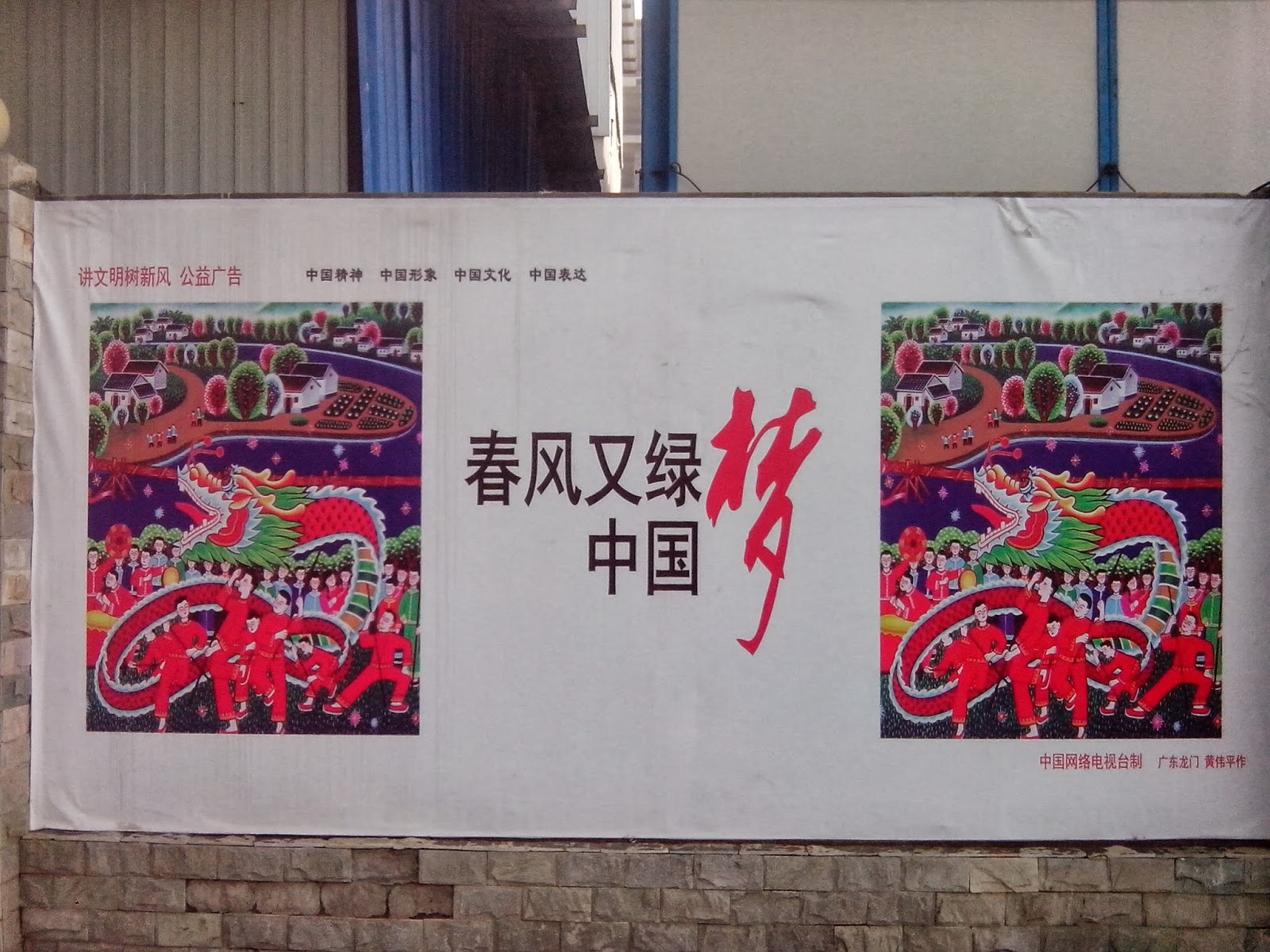
A new campaign has made its way north called Zhongguo Meng: The Chinese Dream. Culture boards all over the country have submitted one or more slogans with beautiful artwork attached. Street by street, the effect is like an outdoor museum of propaganda.


Reading most of the posters is simple enough. Paired with the art, it isn't difficult to understand (or at least guess) their meaning. When a few of them started to trump me and my dictionary, however, I called on Jin Jin. Some have historical references to poems or songs that I hadn't heard of. Some of them include contemporary poetry. They are all concise and poignant in their simplicity. The artwork adds a warmth and aesthetic beauty to the idealistic thoughts shared. It might be propaganda, but it's very moving. Here are a few of my favorites with their translations and Jin Jin's helpful explanations where necessary.


Filial Piety
The Chinese bloodline


Store every grain
Treasure grains and use them prudently


Jin Jin says, "When Xi Jinping [China's new president] came to office his "Chinese Dream" advocated for less waste. In homes and hotels especially, people need to take appropriate measures, so think that "Ke li gui cao" goes along with this idea." 


Get yourself to work
Be well-clothed and well-fed


The nation's dream
A crane circling towards the heavens
 

This particular poster had my brain all twisted for how to translate its poetic sense. First of all, it uses the word "Zhong hua" instead of "Zhong guo" to mean China. Zhong guo is a modern term whereas Zhong hua is an ancient poetic form. According to Jin Jin, it also exudes a more patriotic connotation. In ancient times, the phrase was used to describe the nine states within the nation. The second half of the poster provides an image of a crane, an animal that symbolizes propitiousness in Chinese rhetoric, circling towards the "nine" heavens. As Jin Jin explains: Since "Zhonghua" has nine states, it is only fitting to infer the nine heavens above them. Lastly, instead of just using "meng" to say "dream," they used the term 圆梦, "yuan meng." Jin Jin tells me that it points to the way that China rose up both in ancient and recent times to stand on their own feet, and to the promise that they can continue to rise.


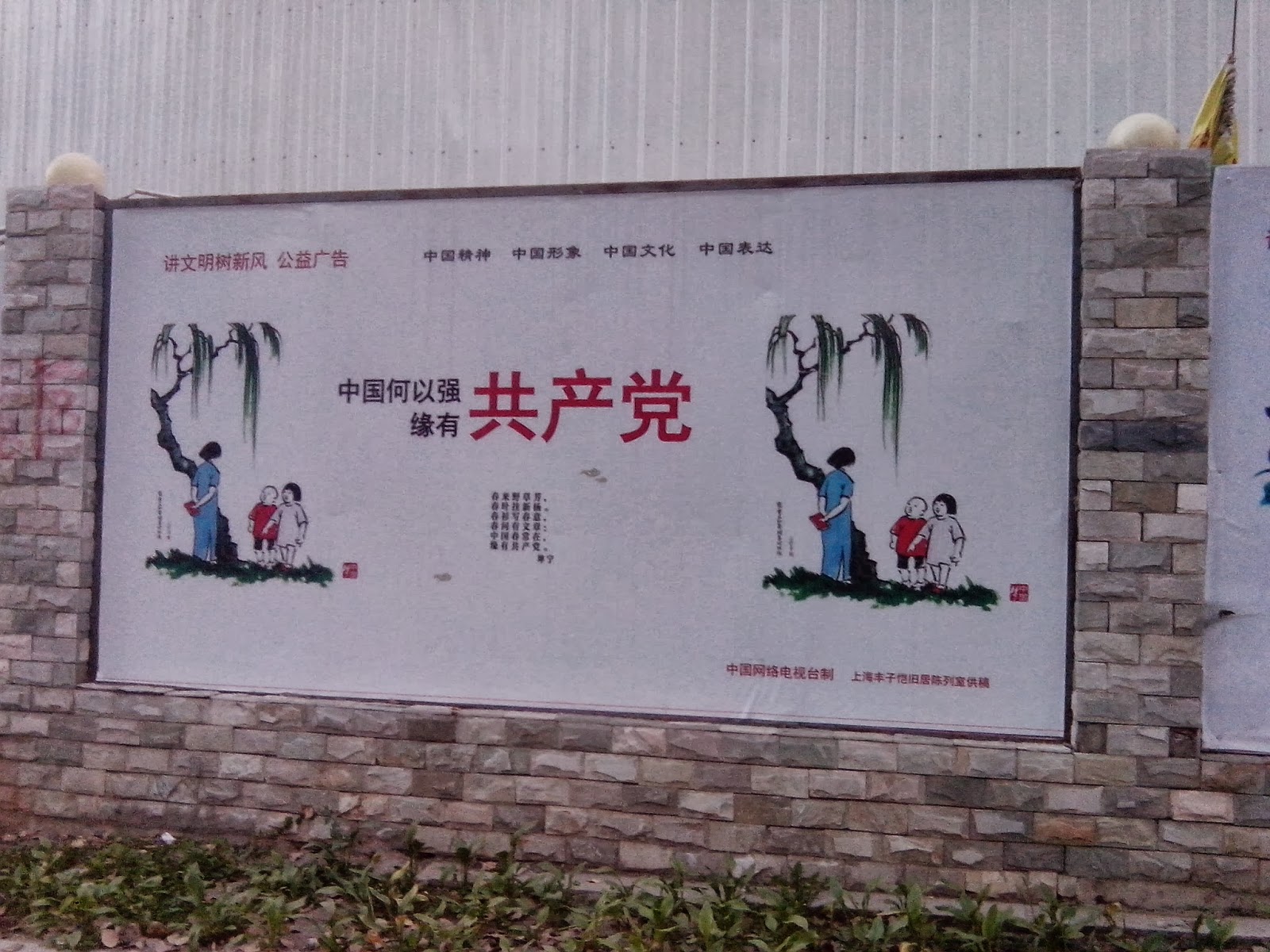
The Communist Party is good
Socialism is good
"Reform and Opening" is good

This is one of my favorites simply for its boldness. It's frank, simple, and full of faith. "Reform and Opening" refers to China's 1978 policy to open its doors to the outside world again.


A spring breeze and a return to green
The China Dream
 
If you look closely at the poster you can see people doing the dragon dance, a tradition after the Chinese New Year, also referred to as the "Spring Festival." At this time of year, the frozen land begins to thaw, trees are graced with leaves again, and flowers begin to bloom. Jin Jin informs me that the first line refers to a famous poem that starts: "A spring breeze and a return to green along the banks of the southern Yangtze." Here, "The Chinese Dream" is written in place of China's famous river, implying that China's dreams are easiest to come by in the spring when everyone is happy and living the sweet life.


My keeping fit
My foretelling
 
There's that "yuan meng" again. It can literally mean a prognostication by dreams, which when combined with the idea of a "Chinese dream," one can understand that it can mean a foretelling of one's rise to success. Here the rise would be through fitness.


Sing of the homeland
"The five stars on ou red flag welcome the wind to make it flutter..."


Hardworkers
have a lot of luck


China--Onward and up!


China's spirit of youth lies in high aspirations
 
Jin Jin informs me, "China has a famous saying: When the young are strong, the country is strong." In the pictures, children are flying kites, symbolizing both their youth and vigor as well as their ability to soar.


Socialism is good
Hundreds of happy children


Why is China strong?
Because it has the Gongchangdang! (a.k.a. Communist Party)


China will live on endlessly


Wednesday, October 2, 2013

5 Things on Pinterest You Won't Find in China

 
October 1, 2013: The 64th anniversary of the People's Republic of China. I woke up to the memorial ceremony at Tiananmen Square where Xi Jinping and the other top-tier CCP members walked around the People's Monument to pay their respects to those who died building the country. On CCTV News, the English channel, they held a Dialogue special where a few of China's top universities' professors came together to debate the "Chinese Dream." During these programs, reporters posed the question, "What does it mean to be Chinese?" 

Although I don't believe that the Chinese public is anywhere near as perplexed by the question of a national identity as some news programs might suggest, I would still like to put in my two jiao. The following are 5 things you will find on Pinterest that you will be hard-pressed to find in China. 
 
 
1. DIY and crafts


Pinterest DIY's
 
 
Pinterest is full of DIY projects and crafts. Whether you're trying to keep your kids busy while you refurbish a vintage dresser or trying to organize your home in twenty steps or less, you won't need to scroll down far before you find exactly what you need. Of course, in China, we call that "hiring someone" (see below). Send your kids to English classes (or calligraphy, or painting, or piano). Hire the company down the street for the remodel. Where will you be, by the way? Oh, that's right. Work.
 
 
Chinese LSEDIFY's (let someone else do it for you) 


2. Teaching tips


Chinese math textbooks
 
I'm using context clues here, but I'm assuming that a lot of teachers use Pinterest to plan and share lessons. If they lived in China that would be completely unnecessary. With the whole country on one system, all they'd have to do is follow the curriculum. Easy as yi, er, san!


3. Anything Weddings: Wedding party, Self-planned color and design schemes, Announcements/invitations, and Cake


A Pinterest wedding party
 

Wouldn't getting married be easier if you just had to pay one company for one of their wedding "sets," banquet included, and just show up looking pretty? Yet I'm sure many of you are thinking, "What fun would that be?!" Simply put, Chinese weddings typically don't involve any of the above.


4. Frosting, Chocolate, and Ryan Gosling


It was only a matter of time before someone thought of this
 

Don't get me wrong, there are plenty of sugary sweets and breads to go around in this country. However, almost none of them can be claimed to be 'homemade.' Also, they are not cream-cheese-frosting sweet. The chocolate isn't anything to brag about either, especially given that their most expensive brand is Dove. Speaking of sweet, is it any wonder that when I search "shuai ge" [handsome men] in Chinese on Baidu (China's Google), the majority of the search results are foreigners (i.e. K-pop stars, Tom Cruise circa 1988, David Beckham)?


5. Internet Memes


The way a Pinterest addict might choose clothes


The way a Chinese student would choose clothes
 

These things are everywhere these days. Well, not everywhere as the only ones I've seen among Chinese friends are more sappy than silly, more cutesy than cool, and more informative than funny. If memes are any inkling of what a given culture is thinking, it only takes one to see how very different thoughts Chinese have from Americans.


You can make of this list what you will. Ok, so you won't find typical China among the how-to's and the grumpy cat memes throughout Pinterest. From the ideas I've posited you might gather that there is a lack of creativity in China, creativity being what Pinterest really boils down to, and which then cannot accurately portray a whole country other than the United States. It doesn't mean that China is all red lanterns and kung fu or even this article. China is only 64 years old! In terms of political states, it's still a baby. How about we at least let it get to it's adolescence before we start deciding which clique it belongs to (I'm talking to you, too, CCTV). Jiayou, China, keep it up!


Monday, September 9, 2013

Xiaolin's Visit part 1

Last week a member of my Changchun family came back "home" for a visit. I've been in his shoes, returning to a place that made me feel independent, loved, and cared for in a lot of new ways. The feeling is extraordinary. On the one hand, you know how to get everywhere. You remember buildings, locations, and all your old haunts. On every street corner you see apparitions of past events and people. On the other hand, however, lives have moved on, including your own, and you become keenly aware that the place you're visiting belongs to your past. It is time travel in the most literal sense.
 
Xiaolin arrives from Tokyo on a Thursday evening. Bi yue, DA3, and I take him to one of the last restaurants he had eaten at before he left a year and a half ago. I'm sure that's the main reason he makes it his first stop. We order old favorites, some with new twists that Xiaolin hasn't tried. We chat and laugh. I introduce Xiaolin to DA3 and they hit it off. I can't say it feels like no time has passed. We spend most of the evening catching up on each other's lives. It just feels easy and natural. It's clear we are old friends with kindred spirits who are happy to be seeing each other face-to-face again. 
 
 
Xiaolin and I


DA3, me, Bi yue, and Xiaolin


The old classmates, Bi yue, Xiaolin, and I
 
Xiaolin only has a week in Changchun and he makes the most of it by planning all his dates before his arrival. He meets friends and teachers throughout the week, which means Bi yue and I get to see him almost every other day. Our dates fall perfectly at mealtimes, a testiment to Xiaolin's efficiency. I tell Xiaolin about the Arabic restaurant in a list of choices for the evening's dinner. He's never had Arabic food, so he chooses that immediately. DA3 and I meet him near the restaurant's location. There we introduce Xiaolin to DA3's friend, Salah, who also helps out at the restaurant. Salah and our waitress surprise everyone with phrase after phrase of Japanese. Xiaolin enjoys the food, the music, the atmosphere, and the waitress' enthusiasm for his language.

 
Salah, Xiaolin, me, and DA3
 
The next day I meet Bi yue, Xiaolin, and our former Chinese teacher, Shen Laoshi, for lunch at a very posh dumpling restaurant. In that DA3 doesn't eat pork, I don't eat it very often these days either. At this restaurant we end up ordering a lot of pork, however, and I unceremoniously eat like a pig--if pigs were cannibals. Shen Laoshi is fun to catch up with as well. I don't see her often now that I've started my major. She's still fantastic about listening to us and talks in a way that makes it easy to understand. We talk for three hours! 

 
Bi yue, Xiaolin, and I with our former teacher, the beautiful Shen Laoshi
 
After lunch, Xiaolin and I go shopping for the dinner I'm going to make him in a couple of days. It's Sunday, so he doesn't have much planned with other friends. He decides to come with me to visit DA3 after shopping. The three of us sit and relax, talking about nothing in particular. We tell stories and reminisce. I suddenly realize that this is what my family did on Sundays growing up. I remember sitting in my grandparents' living room with the TV on, but on one paying attention to it. My dad would sit on the couch, my grandma in her armchair halfway between the front door and the wood stove. Grandpa took whatever other seat was available. They would say things like, "Well, you remember so-and-so, don't you? You know! That Guy's kid! Remember that time we went to such-and-such place to do this or that? We saw That Guy and we talked about whatchamacallit?---Well, it's That Guy's son I'm talking about." My conversation with Xiaolin follows a similar pattern. The hours pass. It feels like home and Xiaolin like family. Xiaolin announces an appointment with another friend. I see him to the bus station.