Showing posts with label language. Show all posts

Saturday, August 23, 2014

My Birthday Poem

In the city of Dandong
two train rides away
a couple of foreigners
celebrated a birthday


Finding an Italian-Japanese sushi place
DA3 cried, "let's stuff our face!"
and Hailan agreed
for some food she did need


Happily they did pass the night
munching on fish and slurping up noodles
when they looked out the window
and saw lanterns gal-oodles! 


So the river they sought
and a purple one they bought.
They wrote some sweet words
in 3 languages, the nerds


The wax was attached
and a fire was lit
for some seconds it heated
while on the boardwalk it sit


When the time came to fly
it rose in the night sky
the foreigners looked on
another birthday had gone


Happy birthday to you
and to you a goodnight!


Sunday, January 26, 2014

T-shirt Translation

The first question most people that have seen the shirt I'm selling ask is, "What does it mean?" It's a totally valid question. No one (in the U.S.) wants to wear a shirt that could easily be blatant swearing, foolish nonsense, or worse, political jargon. (All of these I've seen in China on shirts written in English, by the way). That being said, it is high time I share the meaning of the "Read Between the Strokes" shirt.
 
 
三更灯火
五更鸡
是男儿读书时
黑发不知勤学早
白首方悔读书迟
 
From the dead of the night until dawn
is the time for a man to study
Starting early, a boy doesn't realize it's hard work
The old man regrets studying too late 


Now that you know what the shirt means, does it carry more significance to you? Some people I've talked to say knowing the translation makes it more philosophical, which suits them. What does it mean to you?
 

Monday, October 28, 2013

"The Sound of Youth" Radio Show Interview


Through the International Students' Association, I had the opportunity this week to participate in a radio interview. The show is called "The Sound of Youth" and is a daily program focusing on activities and stories from Changchun's plethora of universities. In our interview, three Chinese students from our association as well as another foreign student, Hadi, and myself discussed life in China and the importance of our club's activities for foreign students. Our hostess particularly enjoyed asking Hadi and I about our experiences studying Chinese and living in China. At one point, she even asked the other students to talk about both Hadi and I as individuals. If it had been television, you would have seen me blushing profusely.

The whole time I kept imagining Changchun's taxi drivers joining in the program. "Not bad," they'd think. "They speak Chinese pretty well," their passengers would reply. Maybe one of the millions out there would wonder, "Have I driven these Lao wai before?"  

Unfortunately for my readers, this interview was all done in Chinese (with the exception of my little English side notes). Nevertheless, if you'd like to listen to it, you can visit their webpage and click on 2013-10-24. (In case you can't remember what my voice sounds like, I'm the slow one that stutters). You might want to skip ahead five or ten minutes past the commercials, or even three-fourths of the way through where they have me sing a song in Chinese. Otherwise, enjoy all the incomprehensible rhythms and the tones! Also, my various tunnels past the Great Firewall have all been failing me lately, so pictures will have to come later.


Thursday, October 17, 2013

The China Dream


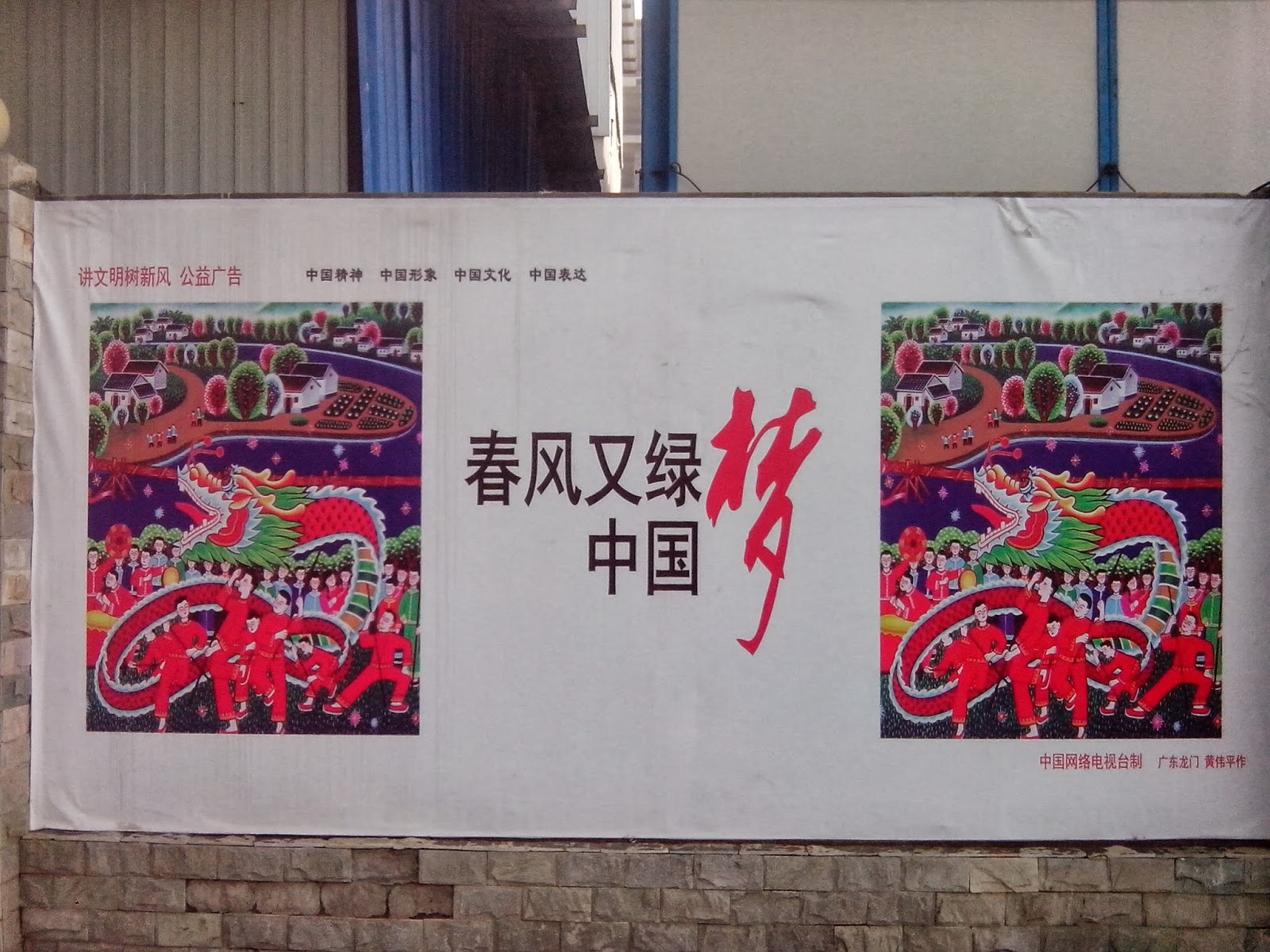
Something's happening underneath Changchun. A subway system is on its way. The ground rumbles with approval. Traffic is happily diverted. Progress won't be stalled, but it's not a pretty sight. So they decided to decorate. 


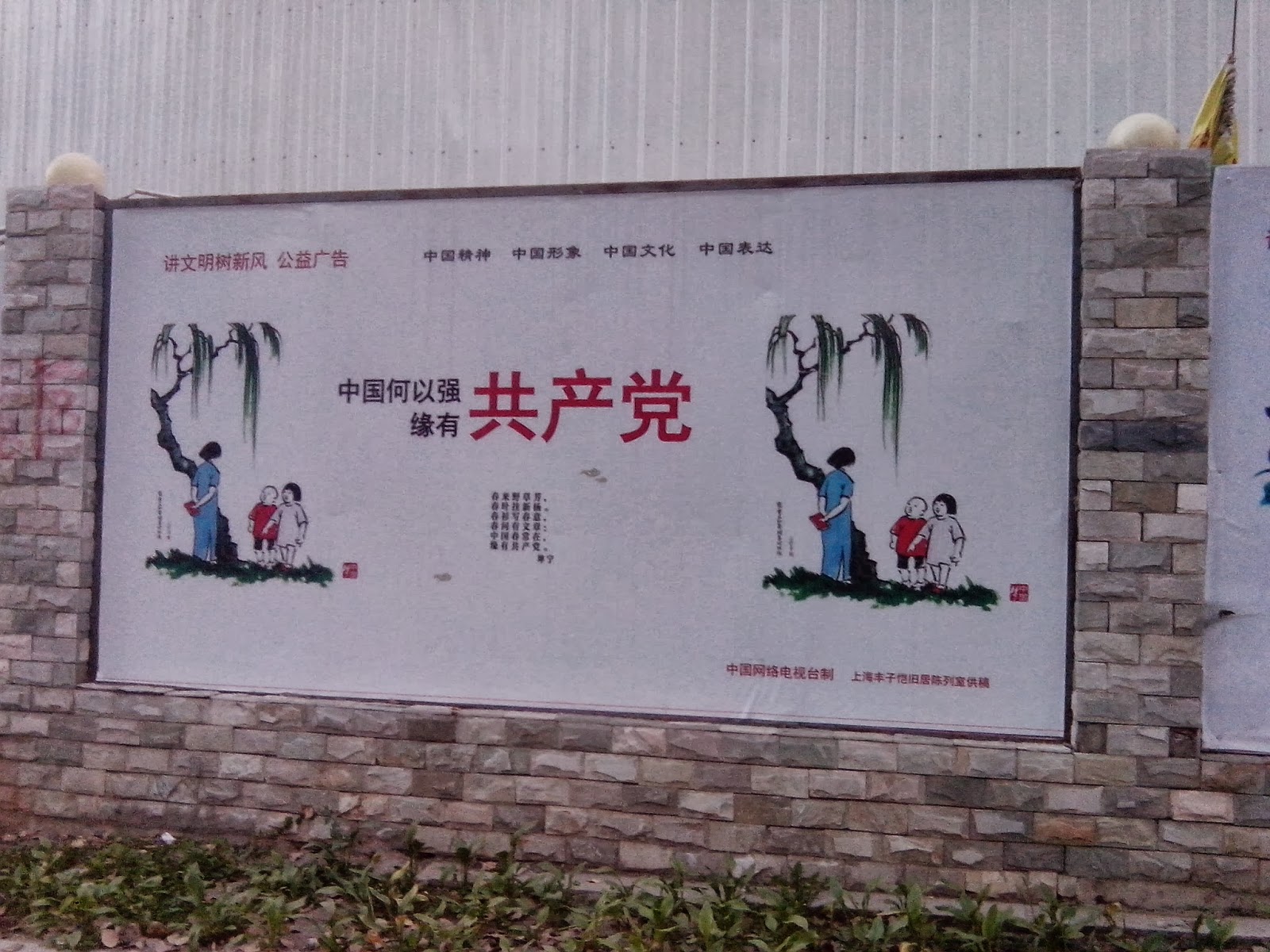
A new campaign has made its way north called Zhongguo Meng: The Chinese Dream. Culture boards all over the country have submitted one or more slogans with beautiful artwork attached. Street by street, the effect is like an outdoor museum of propaganda.


Reading most of the posters is simple enough. Paired with the art, it isn't difficult to understand (or at least guess) their meaning. When a few of them started to trump me and my dictionary, however, I called on Jin Jin. Some have historical references to poems or songs that I hadn't heard of. Some of them include contemporary poetry. They are all concise and poignant in their simplicity. The artwork adds a warmth and aesthetic beauty to the idealistic thoughts shared. It might be propaganda, but it's very moving. Here are a few of my favorites with their translations and Jin Jin's helpful explanations where necessary.


Filial Piety
The Chinese bloodline


Store every grain
Treasure grains and use them prudently


Jin Jin says, "When Xi Jinping [China's new president] came to office his "Chinese Dream" advocated for less waste. In homes and hotels especially, people need to take appropriate measures, so think that "Ke li gui cao" goes along with this idea." 


Get yourself to work
Be well-clothed and well-fed


The nation's dream
A crane circling towards the heavens
 

This particular poster had my brain all twisted for how to translate its poetic sense. First of all, it uses the word "Zhong hua" instead of "Zhong guo" to mean China. Zhong guo is a modern term whereas Zhong hua is an ancient poetic form. According to Jin Jin, it also exudes a more patriotic connotation. In ancient times, the phrase was used to describe the nine states within the nation. The second half of the poster provides an image of a crane, an animal that symbolizes propitiousness in Chinese rhetoric, circling towards the "nine" heavens. As Jin Jin explains: Since "Zhonghua" has nine states, it is only fitting to infer the nine heavens above them. Lastly, instead of just using "meng" to say "dream," they used the term 圆梦, "yuan meng." Jin Jin tells me that it points to the way that China rose up both in ancient and recent times to stand on their own feet, and to the promise that they can continue to rise.


The Communist Party is good
Socialism is good
"Reform and Opening" is good

This is one of my favorites simply for its boldness. It's frank, simple, and full of faith. "Reform and Opening" refers to China's 1978 policy to open its doors to the outside world again.


A spring breeze and a return to green
The China Dream
 
If you look closely at the poster you can see people doing the dragon dance, a tradition after the Chinese New Year, also referred to as the "Spring Festival." At this time of year, the frozen land begins to thaw, trees are graced with leaves again, and flowers begin to bloom. Jin Jin informs me that the first line refers to a famous poem that starts: "A spring breeze and a return to green along the banks of the southern Yangtze." Here, "The Chinese Dream" is written in place of China's famous river, implying that China's dreams are easiest to come by in the spring when everyone is happy and living the sweet life.


My keeping fit
My foretelling
 
There's that "yuan meng" again. It can literally mean a prognostication by dreams, which when combined with the idea of a "Chinese dream," one can understand that it can mean a foretelling of one's rise to success. Here the rise would be through fitness.


Sing of the homeland
"The five stars on ou red flag welcome the wind to make it flutter..."


Hardworkers
have a lot of luck


China--Onward and up!


China's spirit of youth lies in high aspirations
 
Jin Jin informs me, "China has a famous saying: When the young are strong, the country is strong." In the pictures, children are flying kites, symbolizing both their youth and vigor as well as their ability to soar.


Socialism is good
Hundreds of happy children


Why is China strong?
Because it has the Gongchangdang! (a.k.a. Communist Party)


China will live on endlessly


Monday, September 30, 2013

Fall Dance Party

 
The International Student's Association held it's second annual dance party on Saturday. They had me teach two dances. I chose the Macarena and the Cotton-Eyed Joe. Just four months ago I taught the Electric Slide and the Funky Chicken. Once I teach the YMCA and the Hand Jive (probably in another six months or so), I don't know where that will leave my resevoir of 80's group dances!


The "sexy" dance that began the event


Slowing it down with a partner dance


The Koreans brought a new hit--"jumping, jumping, jumping..."


As Chinese dance parties go, a group first performs and then teaches those who want to learn that dance. Everyone else just watches. Talk about wall flowers. Who knew China would be a whole garden?


Waka Waka by a girl from Mali.


The Association has some talented Taiji athletes. This girl flew!


The star in yellow.


Two Russian girls in traditional garb doing a fun quick-footed dance.


Near the end, one of the boys from the Association got down on his knee with a huge bouquet and "proposed" that this girl be his girlfriend.


DA3 got to the campus just before the dance party finished. While I waited for him a boy and a girl approached me and asked me for a favor. They said their club was having a welcome party for their new students. They had asked a couple of foreigners to come, since it's an English club, but now they couldn't get in touch with them. They practically begged me to come to the event, which had already started, to introduce myself, talk with them, and to play games. I told them I'd have to see if DA3 wanted to go and to wait a few minutes for him to come. After a long day, DA3 was not particularly enthusiastic about postponing dinner, but he agreed anyway. We gathered our things and went to the meeting. We were warmly welcomed and immediately rushed on stage. When it was all over, they thanked us profusely with candy and two bottles of Coke. It was kind of fun saving the day!


After the introductions and some games, a group of us sang an English song together. Can you guess which classic 70's hit it was?


Ignoring my Charlie Brown singing face, I'll tell you we were singing The Carpenters' "Yesterday Once More" (hence the Peanuts face).


DA3 had no intention of getting up, but they kind of forced him, so he went and introduced himself. Afterwards he said he was really nervous. The poor guy did a fantastic job playing charades in English, though! (Even if he did forget the word "cry" haha).

Monday, August 12, 2013

Guest Post: Jin Shizhen on Life After China


Today I am very pleased to announce that Day-to-Day China is embarking on a new tradition: guest posts! My first honored guest is a very dear friend of mine. Her name is Kim Sejin (although she gave me the privilege of bestowing her with the English name Samantha). In Chinese she goes by Jin Shizhen. She and I were classmates during my first year in Changchun, when we both studied Chinese and before I started my Master's program. In January of this year Shizhen returned home to Korea to finish her Bachelor's degree after having spent two years in China studying the language. Now she's all graduated and doing some part-time work before heading out again, this time to the English-speaking world! I've asked her to write in Chinese for today, but perhaps when she comes back I'll get her back for an English Round 2. Please welcome Jin Shizhen!


Jin Shizhen and I at last year's Christmas party


Note: The following is written in Chinese, so it's possible that some computers may not be able to read it. Instead of characters or words, what you might see are a lot of little boxes side by side. Don't worry, your computer doesn't have a virus, your eyes are still as close to 20/20 as nature allowed, and, most importantly, your network speed is fine!


真真回韩国以后的生活


你们好!我是李海兰的朋友真真。真真就是我的小名,因为很多西方国家的朋友们觉得我们亚洲人的中文名字很难记,所以有些朋友们叫我真真。我的名字就是金世真。我是从 2011年2 月到2013年 1月在中国吉林省长春市留学。
 
我在中国留学的时间不是很短也不是很长的时间。那段时间内我碰到了好多国家的人,特别是中国人。我在中国觉得虽然中国还没发达了,但在很快得发达。我回韩国来以后也感觉到了,韩国也不是发达的国家。我去北京旅游的时候期待了很多,因为北京是中国的首都,所以肯定会比长春好很多。结果我看到的北京也是一个中国的城市。北京的建筑很好看,不过人们的文化意识还没达到了发达国家的程度。我回韩国来后感觉到的韩国也不是个发达的国家,虽然看起来韩国很干净也很炫耀,但仔细的看就能知道韩国也是一个在努力发达的国家。
    
我在中国认识的中国朋友不是那么多,我的好朋友都是外国人。可能我跟中国学生接触的机会没有那么多,所以我没有很多的中国朋友,但我跟中国人不太亲密的最大原因不是那个。我在上边也写了中国人的文化意识没有那么高。我觉得一看那个人遵守不遵守时间就能知道那个人的文化水平。我到现在碰到的百分之 80的中国朋友都不遵守时间,他们迟到后也没有什么觉得不好意思,有可能他们还不知道怎么表现才好。可是我认识的人都是 20岁以上的成人,不知道怎么表现出不好意思或者感谢的感情的是不像话的。我来韩国以后也见过几个在韩国留学的朋友,他们有的跟韩国人生活便很遵守时间,担忧的完全不是这样。以后我不要跟他们继续交流了。
 
我在中国留学的两年的时间内醉倒的变化就是我的中文水平。虽然我回国以后自己觉得我的中文慢慢退步,但你看,我现在用中文写文章嘛!哈哈 我要使用我的努力学习的中文,因此我现在在韩国仁川机场的免税店打工。因为我在准备去国外留学,所以我要赚钱。我想了又想我要趁着这一个机会能过使用中文的地方打工,结果我在机场的免税店打工。我在这儿打工每天碰到世界各个国家的人。其中最多的就是中国人。我工作的时候就能知道世界各个国家人的特点,我自己觉得很有意思。我来讲一讲。
 
首先,日本人。日本人很安静,但有时候我觉得他们 “看起来” 很安静也很温柔,他们脑子里在想什么呀?我在免税店碰到的大部分的日本人超级安静,也不喜欢麻烦别人。有一次我感觉到了,现在这一个日本顾客对某一个方面不太满意,但不说。我一看他的表情就感觉到了,就觉得很可怕。他们 “看起来” 很温柔,但有不满意的地方也不说,也控制不了自己的表情,好可怕呀。
 
第二,新加坡人。我碰到的新加坡人比较随便花钱。(这是我自己的想法,希望不要误会)可能新加坡人觉得我们韩国的物价低买什么也买得起。但我看来新加坡人买东西的时候不太慎重。
 
第三,很多西方国家的人。我不是写哪国人,而是写很多西方国家的人的原因就是我不知道每个人的国籍(他们大部分都用英语),还有他们是白人还是黑人。没办法,只能这样写。反正,很多西方人很善良,很爱表现出感谢或者不好意思的感情。这是跟着短的话题没有关系的,但我要说一说。我知道有的西方人对陌生人也喜欢打个招呼,也叫陌生人很亲密的称呼。上次一个很有名的美国航空公司的空姐来买东西。(我不要告诉你那个公司的名字,哈哈)她第一次叫我的称呼是 “honey," 第二个称呼是 “baby,” 第三个是 “sweet heart,” 剩下的记不住。我记得她用五六个称呼叫了我。那个情况很有意思了。
 
最后,中国人。中国人很喜欢提问题,跟日本人非常相反。日本人觉得问太多问题会麻烦我,但中国人不管我在跟别的顾客说话,也不管帮别的顾客结账,还问很多问题。中国人很吵。可能是语言的问题,汉语有四个声调,说话的时候都要说出那些声调。我以前以为中文没办法说的时候这么吵,但我在中国也碰到了很多说话说得很安静的人,在工作的时候也碰到了几个一听她说话就觉得他很有文化那样的人。以后才知道了中文也可以用小声说话。
 
我知道我写的内容中比较多的是中国人的缺点。我是喜欢中文,因此我自己愿意去中国留过学的人。所以这是我不是讨厌中国什么的,就是我自己感觉到的中国的真实。希望你们不要骂我。到此为止,谢谢。

P.S. 海兰,我很想你!人家爱你 : )

Thursday, March 14, 2013

人家的第二个家庭


昨天我的朋友将对象带过来我的房间给我介绍一下。我和这个人似乎合得来,她的性格很开朗也很热情。我们俩都喜欢拉家常,特别关于我们在中国的经历或对中国的看法。我们三个差不多刚开始聊天时,我朋友说他要马上回来就走了,把我们闪下。因为我对我朋友知根知底,因此我感觉到他来为征询我对他的选择如何看。反正,无论我怎么看他们俩,但我在这里要强调此时的感情。

这个情况使我认为我与我的朋友的关系变成到家人那样的信任。非常重要记住的就是我们不在自己的国家,而且由于在国外,所以有很多机会跟不同国家的人交流,甚至有时跨国爱情就实现出来。在这时中我们父母都不在我们的身边,而很容易忘记以前的责任,越来越改变自己的思想。这样的扑朔迷离的时光下,该有"第二个家庭",就是说——你的周围该有你相信的朋友们。这样的话就供你立足之地,令你清心。

我为我的朋友快乐,对他和他的对象有望、乐观。我感谢他给我这个为他的责任感,或者说家庭感。